
Principles of Vedic Astrology
The Brilliant Indian System For Determining Our Karma
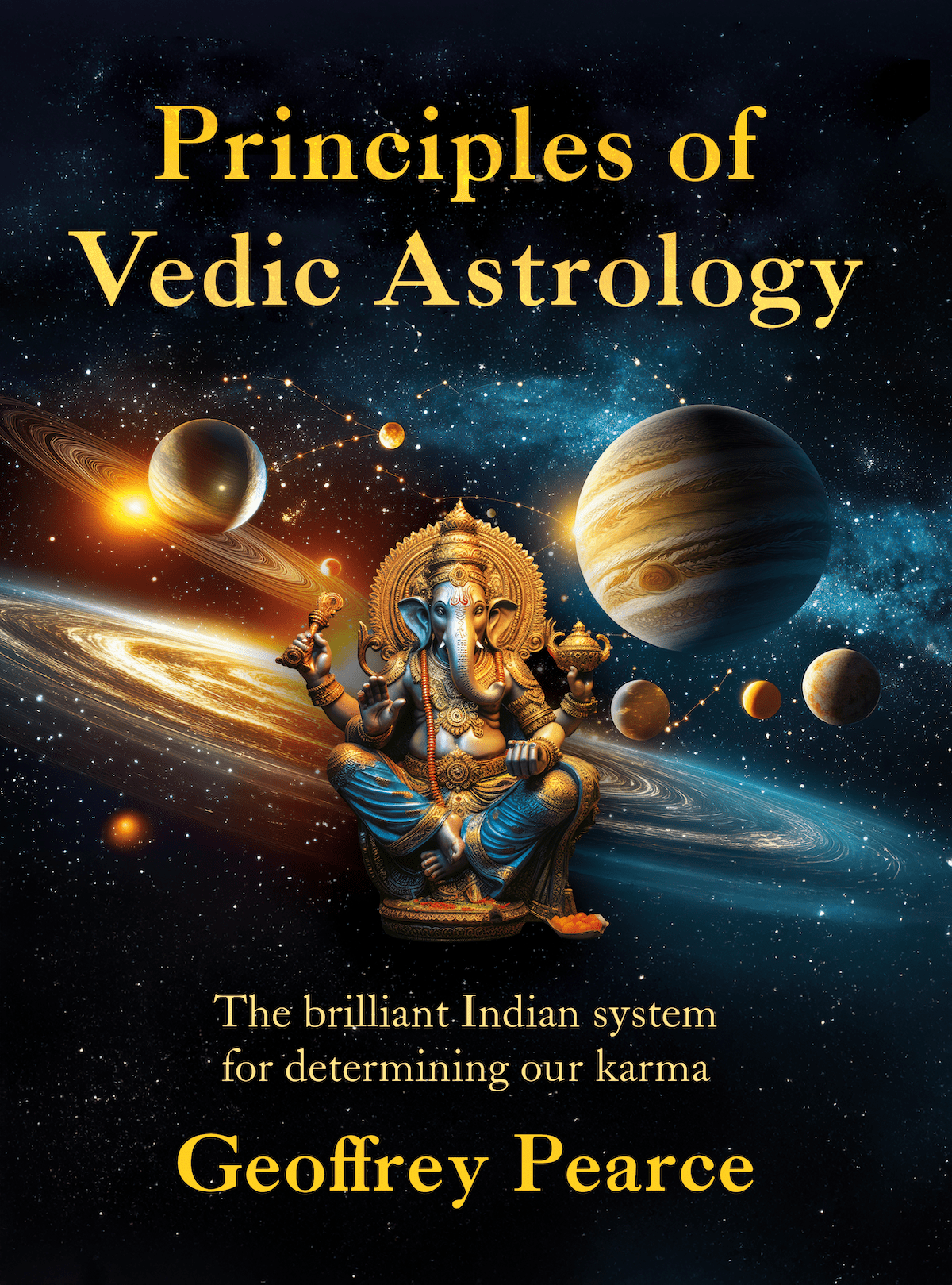
The front cover reminds us that astrology's starting point is the movement of the planets around the solar system in accordance with Time. Sage Maharishi Parashara states, “The Lord Vishnu incarnated as the nine planets to bestow upon living beings the fruits of their actions, or karma. He assumed the auspicious forms of the planets to weaken the strength of the demons (evil forces), to strengthen the power of the gods (the divine beings), and to establish dharma (righteousness, faith, and virtuous actions).
The deity depicted is Shri Ganesha, the presiding deity of Vedic Astrology, who rules over knowledge, mathematics, and karma - the principal subjects covered by this science. He is known as the remover of obstacles, and his help is invoked when starting new endeavours or countering karmic afflictions.
Synopsis
The only textbook on the Vedic astrology that explains the philosophical basics that justify why people should take this subject seriously. It sets out the fundamental knowledge that needs to be known in ways to aid memory, and explains, in greater depth than is to be found in any other publication, how to interpret natal charts to answer questions about someone’s life, supported by examples.
The book also describes how gemstones, mantras, and other remedial measures can help with difficult karma, choosing an auspicious time to begin important activities, and interpreting the charts of nations and international institutions. It also touches on the subject of world cycles affecting humanity, while the appendix contains the first paper given at an international Vedic Astrology conference by the author on Jupiter/Saturn conjunctions and their 884-year cycle that affects everyone and every country.
The book provides unique comprehensive coverage of this ancient science from India, which is gradually becoming more widely known and respected in the West.
What are the book's unique features?
- A detailed explanation of how to interpret natal charts systematically is provided, supported by an interpretation template. Two examples of applying the guidance cover the charts of John Glenn and Arthur Ashe. I believe it to be the most comprehensive and practical guidance available on this core subject, central to the application of Vedic Astrology.
- The material is presented clearly and concisely, with 165 tables provided for easy reference. Verbiage has been kept to a minimum. In the West, most people begin studying this subject in their mid-thirties or early forties, with some starting later. It is not easy to memorise all the details at these ages. Consequently, the book is designed as a reference guide, making it easy to look up required information.
- The chapter on astronomy explains relevant astrological principles derived from observing the sky.
- Eighty planetary combinations (Yogas), subdivided into ten groups, are described to enable readers to utilise this important feature, which facilitates chart interpretation.
- There is an extensive chapter on Divisional Charts, a technique not often covered in textbooks, but its use can significantly facilitate understanding of a person’s life. Jyotishis (Vedic astrologers) always consider the main natal chart and may use up to nineteen divisional charts. These are sub-divisions of every 30° sign in the primary chart, each specialising in a particular area of the person’s life. For example, the one-ninth chart aids the analysis of marriage prospects and timing, while the one-tenth chart relates to a person’s career. This chapter concentrates on the nine most critical divisional charts and includes unique information based on my research.
- Three chapters detail how to analyse a chart concerning marriage and relationships, careers, and health.
- The original Vedic astrological system is believed to have been based on twenty-seven fixed stars, called “Nakshatras, " not the twelve zodiac signs. Nakshatras are connected to the Moon, representing the mind, and are all-important, as nothing in the physical world occurs unless the mental realm permits it. There is generally excellent information about nakshatras, so I have summarised their details in tabular format for greater clarity. A chapter entitled “Tara Bala” illustrates how their influence on a person’s life varies over time, depending on their distance from the nakshatra in which the natal Moon is located.
- Vedic Astrology features a sophisticated method for timing significant events in an individual’s or a nation’s life, known as the Vimshottari Dasha System. Chapter Ten explains this system in detail and summarises other dasha systems used in particular circumstances. Two chapters on Transits and Ashtakavarga help readers accurately assess the likely outcomes of a planet's dasha period.
- The Law of Karma provides every person with an opportunity to learn from their mistakes in past lives. Two shadow planets that directly express this law are Rahu and Ketu, the nodes of the Moon located 180 degrees apart in the natal chart, and their positions are known as “The Karmic Axis.” Chapter Seventeen explains how this axis relates to the four aims of life, their numerous significations, and other information that every student needs to know about these two highly relevant planets.
- A further chapter, entitled “Planets and Their Karmic Tendencies,” illustrates various situations in which Rahu and Ketu can create problems for individuals when they are in close proximity to other planets. Additionally, diverse planetary conditions are explained, which affect a person’s mental strengths and weaknesses, creating karmic events and patterns in their life.
- People generally start an action, such as moving house or marriage, at the most convenient time. In ignorance, they believe that “It is my time”. Jyotish demonstrates through a sub-system called “Murhurta” that it is God’s, or the Universe’s, time. The chapter on muhurta explains how this system helps people initiate activities at auspicious times, thereby avoiding potential problems when they choose a time that is convenient for them. Most related calculations are in a separate module within modern Jyotish computer programs.
- Another subject, usually confined to separate textbooks, is political astrology, applying the system to countries' charts. In Chapter Twenty-Five, entitled “Mundane Astrology,” the significations of the planets and houses are presented to illustrate their relationship to countries. The concept of identifying the moment a nation is born is explained, and a table is provided containing the latest birth information for forty-seven states and international organisations.
- Some people are highly spiritual or religious. The rules in Chapter Twenty-Six, “Moksha Houses and Pravaraja Yogas”, help identify this characteristic in a person’s chart.
- Karma may bring misfortune, unhappiness, and stress. A Jyotishi should never deliver terrible news about events a person is likely to face without providing some form of comfort by recommending a “Remedial Measure”. In Chapter Twenty-Seven, various types of assistance that may be prescribed are explained, depending on the client's capabilities and inclinations.
- The primary source for the material in this book is a classical Sanskrit text, Brihat Parashara Hora Shastra (BPHS in brief). Therefore, this book contains many Sanskrit words explained in a glossary. The Sanskrit-English Dictionary, compiled by Sir M. Monier-Williams, has been used in their translation. To assist interested readers, I have included the page and column numbers to help them locate the Sanskrit words in the dictionary. The date when BPHS was initially written is unknown. The current version may have been compiled in the sixth century CE. It includes “Rashi-based” techniques similar to those found in Jaimini’s Upadesa Sutras. The “Jaimini” principles outlined in BPHS have been largely excluded from this book, as they are complex and more suitable for advanced students.
- Among the Appendices is a page showing Shri Yukteswar’s 24,000-year cycle of human intellectual powers, as mentioned in his book, The Holy Science. He explains that humanity is not living in the early part of the Age of Iron (also known as “Kali Yuga”), which, according to some ancient classical texts, lasts 432,000 years that began in 3102 BCE. He writes that at the end of the sixteenth century CE, the general level of consciousness rose as humanity transitioned into the Bronze Age that will dominate the next 2,000 years. The discovery of electricity happened at that time, ushering in the scientific age. Because his data was approximate, I have shown the dates for his entire cycle based on modern astronomical calculations.
- The planetary combination that has the most significant effect on humanity is the 884-year cycle of Jupiter/Saturn conjunctions, which ties in with historical developments in Europe and elsewhere. An appendix contains a transcript of my talk to the American Council of Vedic Astrology Conference in January 2000, outlining my research into this subject.
- Finally, the book explains the subject's natural laws and philosophical principles based on the teachings of enlightened Indian sages. This guidance ensures that the Vedic Astrological system makes rational sense to those seeking the truth about life, the forces that affect every person in every age, and the real purpose of human embodiment.
Principles of Vedic Astrology
Book's Chapter Headings
- Chapter One: Differences Between Vedic and Western Systems
- Chapter Two: Natural Law and Philosophical Principles
- Chapter Three: Astronomy
- Chapter Four: Planets (Grahas)
- Chapter Five: Signs of the Zodiac (Rashis)
- Chapter Six: Houses (Bhavas)
- Chapter Seven: South and North Indian Chart Styles
- Chapter Eight: Fixed Stars (Nakshatras)
- Chapter Nine: Planetary Combinations (Yogas)
- Chapter Ten: Timing of Events (Dasha System)
- Chapter Eleven: Transits (Gochara)
- Chapter Twelve: Divisional Charts (Vargas)
- Chapter Thirteen: Natal Charts Interpretation Rules
- Chapter Fourteen: Chart Interpretation Examples
- Chapter Fifteen: Nakshatras’ Strengths (Tara Bala)
- Chapter Sixteen: Strength of Planets’ Transits (Ashtakavarga)
- Chapter Seventeen: Rahu and Ketu, The Karmic Axis
- Chapter Eighteen: Marriage and Relationships
- Chapter Nineteen: Careers
- Chapter Twenty: Health and Diseases
- Chapter Twenty-One: Moveable Significators (Chara Karakas)
- Chapter Twenty-Two: Planetary Combination Showing Karmic Tendencies
- Chapter Twenty-Three: Planetary Strengths and States
- Chapter Twenty-Four: Electional Astrology (Muhurta)
- Chapter Twenty-Five: Mundane Astrology – Interpreting Nations Charts
- Chapter Twenty-Six: Moksha Houses and Pravaraja Yogas
- Chapter Twenty-Seven: Remedial Measures
- Appendices:
- 1. Wishes Granted Through Each of the Twenty-Seven Nakshatras
- 2. Jupiter/Saturn Conjunctions and Historical Cycles Talk